© Colin Usher practicing as MicroTecture c 2025


Our Home —
A Real World Ultra Low Energy House: page 1
19 Lang Lane:
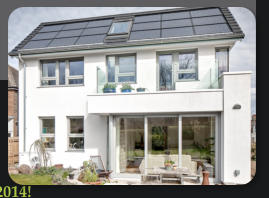
Probably the best house in the UK, as judged in 2014!
A Home Designed to Learn From In 2012/13, my wife Jenny and I built our own home — a project that brought together everything I’d learned about architecture, building physics and low energy design. We wanted a house that was warm, quiet, healthy and affordable to run. More than that, we wanted to understand how a low energy building really behaves when you live in it every day. This home has become a living laboratory. It has shaped my approach to design and deepened my belief that comfort, simplicity and performance should sit at the heart of every project. ________________________________________ Designing for Comfort, Health and Low Energy From the outset, we focused on the fundamentals: • Excellent insulation to reduce heat loss • Airtight construction to eliminate draughts • Mechanical ventilation with heat recovery (MVHR) for fresh, filtered air • Careful orientation to make the most of natural light • Simple, compact form to minimise energy demand • Fabric first detailing to ensure performance is built in, not bolted on These principles are inspired by Passive House thinking, but adapted to our needs, our budget and our site. ________________________________________ Living in the House: What We’ve Learned The most valuable insights came after we moved in. Living in the building every day revealed things that no model or drawing can fully capture. 1. The comfort is transformative The house maintains a remarkably stable temperature. There are no cold corners, no draughts and no rooms that feel “second class”. Winter mornings are warm without needing to boost the heating. 2. Fresh air makes a huge difference The MVHR system quietly provides a constant supply of filtered air. The house never feels stuffy, and humidity stays balanced — even when cooking, showering or drying clothes indoors. 3. Energy use is extremely low Because the building loses so little heat, the heating system barely needs to run. Our energy bills are a fraction of what they would be in a typical home of the same size. 4. Small details matter Airtightness tapes, window installation, junction detailing — these are the things that determine whether a building performs as intended. Good design is only half the story; good execution is the other half. 5. Simplicity beats complexity We avoided unnecessary technology. The house works because the fabric does the heavy lifting. This makes it easier to live with, easier to maintain and more resilient in the long term. ________________________________________


© Colin Usher practicing as MicroTecture c 2025


Our Home —
A Real World Ultra Low Energy House: page 1
19 Lang Lane:
Probably the best house in the UK, as judged in 2014!
A Home Designed to Learn From In 2012/13, my wife Jenny and I built our own home — a project that brought together everything I’d learned about architecture, building physics and low energy design. We wanted a house that was warm, quiet, healthy and affordable to run. More than that, we wanted to understand how a low energy building really behaves when you live in it every day. This home has become a living laboratory. It has shaped my approach to design and deepened my belief that comfort, simplicity and performance should sit at the heart of every project. ________________________________________ Designing for Comfort, Health and Low Energy From the outset, we focused on the fundamentals: • Excellent insulation to reduce heat loss • Airtight construction to eliminate draughts • Mechanical ventilation with heat recovery (MVHR) for fresh, filtered air • Careful orientation to make the most of natural light • Simple, compact form to minimise energy demand • Fabric first detailing to ensure performance is built in, not bolted on These principles are inspired by Passive House thinking, but adapted to our needs, our budget and our site. ________________________________________ Living in the House: What We’ve Learned The most valuable insights came after we moved in. Living in the building every day revealed things that no model or drawing can fully capture. 1. The comfort is transformative The house maintains a remarkably stable temperature. There are no cold corners, no draughts and no rooms that feel “second class”. Winter mornings are warm without needing to boost the heating. 2. Fresh air makes a huge difference The MVHR system quietly provides a constant supply of filtered air. The house never feels stuffy, and humidity stays balanced — even when cooking, showering or drying clothes indoors. 3. Energy use is extremely low Because the building loses so little heat, the heating system barely needs to run. Our energy bills are a fraction of what they would be in a typical home of the same size. 4. Small details matter Airtightness tapes, window installation, junction detailing — these are the things that determine whether a building performs as intended. Good design is only half the story; good execution is the other half. 5. Simplicity beats complexity We avoided unnecessary technology. The house works because the fabric does the heavy lifting. This makes it easier to live with, easier to maintain and more resilient in the long term. ________________________________________